





What is the ductility of titanium material?
May 15, 2025
Leave a message
Hey there! As a titanium material supplier, I often get asked about the ductility of titanium material. So, let's dive right into it and figure out what this ductility thing is all about.
First off, what exactly is ductility? Well, in simple terms, ductility is the ability of a material to be stretched or drawn into a thin wire without breaking. It's like when you take a piece of taffy and pull it gently, and it just keeps getting longer and longer. That's a high - ductility material. In the world of metals, ductility is super important because it affects how we can shape and use the metal in different applications.
Now, let's talk about titanium. Titanium is an amazing metal with some really cool properties. It's strong, lightweight, and resistant to corrosion. And when it comes to ductility, titanium has some interesting characteristics.
Titanium has a relatively high ductility compared to many other metals. This means that we can form it into various shapes quite easily. For example, we can make thin sheets of titanium that are used in aerospace applications. The high ductility allows these sheets to be bent and formed into the complex shapes needed for airplane parts.
One of the reasons for titanium's good ductility is its crystal structure. Titanium has a hexagonal close - packed (HCP) crystal structure at room temperature. This structure gives it a certain amount of flexibility when it comes to deformation. When a force is applied to titanium, the atoms in its crystal lattice can move and slide past each other, allowing the metal to stretch without immediately fracturing.
However, the ductility of titanium isn't a fixed value. It can be affected by several factors. One of the big factors is the purity of the titanium. Pure titanium generally has better ductility than titanium alloys. In pure titanium, there are fewer impurities and alloying elements to disrupt the crystal structure. This allows the atoms to move more freely, resulting in higher ductility.
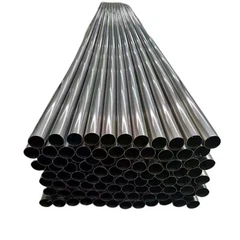
For instance, commercially pure titanium, like Grade 2 (GR2), is known for its good ductility. Our GR2 Seamless Titanium Tube is made from high - quality Grade 2 titanium. This high ductility makes it easy to bend and shape the tube according to different project requirements. Whether you're using it in a chemical processing plant or for a marine application, the ductility of the GR2 seamless titanium tube ensures that it can be adapted to fit the specific needs of your project.
Another factor that affects titanium's ductility is the temperature. At higher temperatures, titanium becomes more ductile. This is because the increased thermal energy allows the atoms to move more easily within the crystal lattice. In industrial processes, we often use heat treatment to improve the ductility of titanium parts. By heating the titanium to a specific temperature and then cooling it at a controlled rate, we can optimize its ductility and other mechanical properties.
Titanium alloys also play an important role in the world of ductility. While some alloys may have slightly lower ductility compared to pure titanium, they offer other benefits such as increased strength. For example, alloying titanium with elements like aluminum, vanadium, or iron can enhance its strength while still maintaining a reasonable level of ductility. Our Alloy Tube Seamless Titanium is a great example of this. These alloy tubes are designed to provide a balance between strength and ductility, making them suitable for a wide range of applications, from automotive parts to medical devices.
In addition to forming thin wires and sheets, the ductility of titanium is also crucial when it comes to welding. A material with good ductility is more likely to withstand the stresses and strains that occur during the welding process without cracking. This is important because many titanium components are assembled using welding techniques. For example, in the construction of large - scale structures like bridges or offshore platforms, titanium parts need to be welded together. The ductility of the titanium ensures that the welded joints remain strong and reliable.
Let's also talk about large - caliber titanium products. Our Titanium Stub End Large Caliber is a product where ductility plays a key role. These large - caliber stub ends need to be able to be machined and joined to other components. The ductility of the titanium allows for precise machining operations, ensuring that the dimensions of the stub end are accurate. And when it comes to joining it to other parts, the ductility helps to prevent cracking during the welding or fitting process.

So, why is all this important to you as a potential buyer? Well, if you're in an industry that requires the shaping and forming of metal parts, the ductility of titanium can save you a lot of time and money. You won't have to worry as much about the material breaking or cracking during the manufacturing process. And since titanium is a durable and corrosion - resistant metal, parts made from it will have a long service life.
Whether you're in the aerospace, automotive, medical, or any other industry that uses titanium materials, understanding the ductility of titanium can help you make better decisions about which products to choose. If you need a material that can be easily formed into complex shapes, pure titanium or a low - alloy titanium product might be the way to go. On the other hand, if you need a combination of strength and some ductility, a titanium alloy could be a better option.
If you're interested in learning more about our titanium products or have any questions regarding the ductility of titanium and how it can benefit your project, don't hesitate to reach out. We're here to help you find the perfect titanium material for your needs. Whether you need a small quantity for a prototype or a large order for a full - scale production, we've got you covered.
Let's start a conversation and see how we can work together to make your project a success. Contact us today to discuss your requirements and get a quote. We look forward to hearing from you!

References
- ASM Handbook Volume 2: Properties and Selection: Nonferrous Alloys and Special - Purpose Materials
- Titanium: A Technical Guide by John C. Williams
Send Inquiry