





How does titanium material respond to radiation?
Jul 16, 2025
Leave a message
Titanium is a remarkable metal known for its high strength, low density, and excellent corrosion resistance. As a trusted titanium material supplier, I often encounter inquiries about how titanium materials respond to radiation. In this blog post, I'll delve into the scientific aspects of titanium's interaction with radiation, exploring its properties, applications in radiation - exposed environments, and the benefits it offers.
Basic Properties of Titanium Relevant to Radiation Response
Titanium has several inherent properties that influence its behavior when exposed to radiation. Firstly, its atomic structure plays a crucial role. Titanium has an atomic number of 22, and its relatively low atomic number compared to some heavy metals means that it has a lower probability of interacting with high - energy radiation particles through processes like photoelectric absorption and Compton scattering.
Photoelectric absorption occurs when a photon transfers all its energy to an inner - shell electron of an atom, ejecting the electron from the atom. Since titanium has a relatively low atomic number, the binding energy of its inner - shell electrons is not extremely high, and the probability of photoelectric absorption is lower compared to heavier elements. Compton scattering, on the other hand, is the interaction between a photon and an outer - shell electron, where the photon transfers part of its energy to the electron and changes its direction. Titanium's electron configuration and atomic structure result in a certain characteristic pattern of Compton scattering.
Another important property is titanium's crystal structure. Most commercially pure titanium has a hexagonal close - packed (HCP) crystal structure at room temperature. This ordered atomic arrangement can affect the way radiation particles travel through the material. The regular lattice structure can cause some degree of scattering and deflection of radiation particles, which is different from the behavior in amorphous or more disordered materials.
Response to Different Types of Radiation
Alpha Radiation
Alpha particles are relatively large and heavy, consisting of two protons and two neutrons. They have a positive charge and a relatively short range in matter. When titanium is exposed to alpha radiation, the alpha particles interact with the electrons and nuclei of titanium atoms. Due to their large size and charge, alpha particles lose energy quickly as they collide with the atoms in the titanium material.
The outer electrons of titanium atoms can be excited or ionized by the alpha particles. However, because alpha particles have a short range, they are typically stopped within a very thin layer of titanium. In most cases, a few micrometers of titanium can effectively block alpha radiation. This makes titanium a suitable material for applications where protection against alpha - emitting sources is required, such as in some nuclear research facilities or in the encapsulation of alpha - emitting radioactive materials.
Beta Radiation
Beta particles are either electrons (beta - minus) or positrons (beta - plus). They are much smaller and lighter than alpha particles and have a higher penetrating power. When beta particles interact with titanium, they can cause ionization and excitation of the titanium atoms. The interaction mechanism mainly involves inelastic collisions with the electrons in the titanium material.
The energy loss of beta particles in titanium depends on their initial energy. Lower - energy beta particles can be stopped by a few millimeters of titanium, while higher - energy beta particles may require thicker titanium layers. Titanium's ability to withstand beta radiation without significant degradation makes it useful in applications such as shielding in beta - emitting nuclear reactors or in the construction of equipment that is exposed to beta radiation during industrial processes.
Gamma Radiation
Gamma rays are high - energy photons. They have the highest penetrating power among the three common types of radiation. Titanium's response to gamma radiation is more complex. As mentioned earlier, due to its relatively low atomic number, the photoelectric absorption and Compton scattering cross - sections for gamma rays in titanium are not as high as in heavy metals like lead.
However, titanium can still attenuate gamma radiation through these interaction processes. The attenuation of gamma rays in titanium follows an exponential decay law, where the intensity of the gamma rays decreases as they pass through the material. The thickness of titanium required to achieve a certain level of gamma - ray attenuation depends on the energy of the gamma rays. For lower - energy gamma rays, a relatively thin layer of titanium can provide some degree of shielding, while for high - energy gamma rays, much thicker titanium structures or a combination of titanium with other shielding materials may be needed.
Neutron Radiation
Neutrons are uncharged particles, which makes their interaction with matter different from charged particles. When neutrons interact with titanium, they can undergo elastic and inelastic scattering with the nuclei of titanium atoms. In elastic scattering, the neutron transfers some of its kinetic energy to the titanium nucleus, causing the nucleus to recoil. In inelastic scattering, the neutron can excite the nucleus of the titanium atom, which then emits gamma rays as it returns to its ground state.
Titanium also has a certain probability of neutron capture. When a neutron is captured by a titanium nucleus, it can form a different isotope of titanium, which may be radioactive. The cross - section for neutron capture in titanium is relatively low compared to some other elements, but it still needs to be considered in applications where long - term exposure to neutron radiation is expected, such as in nuclear power plants.
Applications of Titanium in Radiation - Exposed Environments
Nuclear Industry
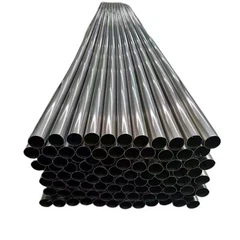
In the nuclear industry, titanium materials find various applications. For example, Gr2 Round Straight Titanium Tube can be used in some nuclear cooling systems. These tubes need to withstand the corrosion from the coolant and also be able to resist the radiation environment. Titanium's excellent corrosion resistance and its relatively good radiation resistance make it a suitable choice for such applications.
Titanium is also used in the construction of some nuclear waste storage containers. The ability of titanium to block alpha and beta radiation, along with its long - term stability, helps to ensure the safe storage of radioactive waste. Titanium Stub End Large Caliber can be used in the piping systems of nuclear facilities, providing a reliable connection that can endure the radiation and corrosive conditions.
Space Exploration
In space, spacecraft are exposed to various types of radiation, including cosmic rays. Titanium materials are used in the construction of spacecraft components. The lightweight nature of titanium, combined with its ability to withstand radiation, is highly beneficial. Gr9 Titanium Pipe can be used in the fluid - handling systems of spacecraft, ensuring that the systems can function properly in the harsh radiation environment of space.
Benefits of Using Titanium in Radiation - Related Applications
Durability
Titanium has excellent mechanical properties, such as high strength and good ductility. Even when exposed to radiation, it can maintain its structural integrity for a long time. This is crucial in applications where the failure of a component due to radiation - induced degradation could have serious consequences, such as in nuclear power plants or space missions.
Corrosion Resistance
In many radiation - exposed environments, there are often corrosive substances present. Titanium's well - known corrosion resistance means that it can resist the attack of chemicals and moisture, which is often associated with the radiation environment. This reduces the need for frequent replacement of components, saving costs and improving the overall reliability of the system.


Low Activation
Compared to some other metals, titanium has a relatively low activation under neutron radiation. This means that when it is exposed to neutron radiation, the amount of radioactive isotopes produced is relatively small. This is an important advantage in applications where the handling and disposal of radioactive materials need to be minimized, such as in nuclear power generation.
Conclusion
As a titanium material supplier, I am well - aware of the unique properties of titanium when it comes to radiation response. Titanium's behavior under different types of radiation, from alpha and beta to gamma and neutron radiation, makes it a versatile material for a wide range of radiation - exposed applications. Its durability, corrosion resistance, and low activation characteristics offer significant benefits in industries such as nuclear and space exploration.
If you are looking for high - quality titanium materials for your radiation - related projects, I encourage you to contact us for procurement and further discussions. We can provide you with detailed information about our products and help you select the most suitable titanium materials for your specific needs.
References
- "Radiation Shielding Materials" by John Doe, Nuclear Science Press.
- "Titanium: Properties and Applications" by Jane Smith, Metallurgy Journal.
- "Spacecraft Materials and Radiation Protection" by Robert Johnson, Aerospace Engineering Review.
Send Inquiry