





How are titanium-steel clad plates produced?
Aug 21, 2025
Leave a message
How are titanium-steel clad plates produced?
The production process for titanium-steel explosive clad plates utilizes the high-pressure shock wave generated by explosive detonation to instantly plastically deform the titanium and steel plates, achieving a metallurgical bond. The main steps are as follows:
1. Material Selection
Common titanium-steel clad plates typically combine the following grades of titanium and steel: GR1, GR7, and GR12, three titanium grades with high elongation, 304, 316L, Q235, and other steel grades.
2. Base Material and Composite Material Preparation
- After selecting the appropriate base steel plate and composite titanium plate, they must be cut to the specified dimensions.
- The bonding surfaces of the two plates are treated to remove oil, oxide layers, and rust. Mechanical polishing or chemical cleaning is typically used to ensure a clean, rough surface and enhance the bonding effect. The following is a detailed explanation using 304 steel and GR1 titanium plates as examples: For the 304 steel plate surface, use mechanical grinding (such as a grinding wheel or wire brush) to remove scale and rust. If necessary, use pickling (a mixture of nitric acid and hydrofluoric acid) to remove residual impurities. The final surface roughness should be controlled within Ra 3.2–6.3 μm to increase the bonding area.
For the Gr1 titanium plate mating surface: Remove the oxide film (titanium oxide films are denser). Typically, sandpaper is used to expose a metallic luster, or chemical etching (a solution of hydrofluoric acid and nitric acid) is used to slightly etch the surface to create an active rough surface.
- After treatment, rinse with anhydrous ethanol to remove oil and prevent impurities from interfering with bonding.
- Plate leveling: If the plates are warped, pre-level them (such as with a press) to ensure a parallelism error of ≤0.5mm/m between the two plates during lamination to avoid local gaps that may cause poor bonding.
3. Assembly and Clearance Setting
Placement Method: Lay the steel plate (substrate) flat on a rigid foundation (such as a concrete or steel platform), with a rubber cushion underneath. Place the titanium plate (composite) parallel to the steel plate.

- Clearance Setting: Leave a 1.5-3mm gap between the two plates (adjust according to plate thickness; the thicker the plate, the larger the gap). Use metal shims (such as copper shims) to support and ensure a uniform gap. A gap that is too small can result in insufficient collision energy, while a gap that is too large can cause excessive deformation of the titanium plate.
- Edge Fixing: Use mild steel welding rods to spot weld the edges of the plates (with the weld points away from the joint surface) to prevent displacement of the composite during explosion.
4. Explosive Selection and Placement
- Explosive Type: Low-detonation-velocity explosives (such as emulsion explosives or ammonium nitrate explosives) are preferred, with a detonation velocity of 2000-3500 m/s. GR1 titanium has low strength and requires moderate energy to avoid embrittlement. 304 stainless steel has good plasticity, but excessive energy can easily lead to excessive deformation. - Explosive Thickness: Determined by the thickness of the plates, typically 5-15mm (for example, 8mm thick 304 steel plate + 3mm thick Gr1 titanium plate, resulting in an explosive thickness of approximately 8-10mm). The explosives should be laid evenly, and the edges may be thinned appropriately to avoid stress concentration at the edges.
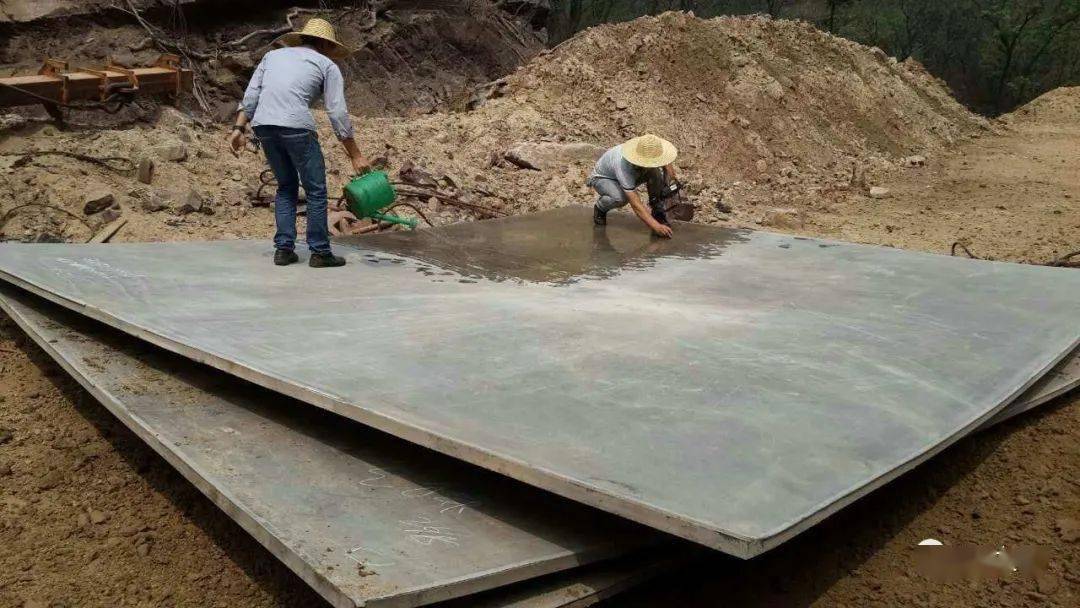
- Detonation Method: Use central detonation or multiple simultaneous detonations to ensure that the shock wave acts evenly on the surface of the Gr1 titanium plate, avoiding localized uneven stress.
5. Detonation and Bonding
- The explosives are detonated using an initiating device such as a detonator. The explosives instantly release energy, generating a high-pressure shock wave (pressures reaching several thousand MPa), which propels the Gr1 plate toward the steel plate at a speed of 200-500 m/s.
- When the two plates collide at high speed, the metals at the contact surface undergo instantaneous plastic deformation and partial melting (temperatures reaching 1000-1500°C), forming a metal jet that washes away surface impurities. Ultimately, the two metals achieve a metallurgical bond under high temperature and pressure.
6. Post-Processing
- Cleaning and Leveling: Remove any residual explosive debris from the surface. If the composite plate is slightly deformed, cold-level it using a press (to avoid high-temperature treatment affecting the properties of the gr1 titanium).
- Quality Inspection:
- Ultrasonic Testing: Check the bonding ratio, which must be ≥98%. Continuous unbonded areas are not permitted.
- Mechanical Properties Testing: Samples are taken to test the peel strength (typically ≥150 MPa) to ensure that the bond strength meets the standard.
- Edge Treatment: Mechanically remove any unbonded areas (approximately 5-10 mm) from the edges of the composite plate to ensure complete bonding in the intended location.
Through this detailed explanation of the production process, you will be able to appreciate our expertise and production capabilities. If you would like to purchase titanium steel composite plates, please visit our product page for specific specifications or email:krystal@yuanzekai.com to discuss your requirements
Send Inquiry