





What is the standard for stainless steel cathode plates?
Mar 12, 2025
Leave a message
1. Material standards
Stainless steel cathode plates should be made of high-quality 304L or 316L stainless steel materials, and their chemical composition should comply with the provisions of GB/T20878-2007 "Stainless Steel and Heat-resistant Steel Grades and Chemical Compositions". When purchasing stainless steel cathode plates, ensure that their materials meet the requirements to ensure safety and life.
T/ZZB 0238-2017 standard specifies the structural type, basic requirements, technical requirements, test methods, inspection rules, marking, packaging, transportation and storage, and quality service commitment of stainless steel cathode plates. This standard is applicable to the copper electrolytic refining industry, and uses stainless steel plates as cathode deposition surfaces to precipitate high-purity plate-shaped cathode copper.
2. Stainless steel cathode components
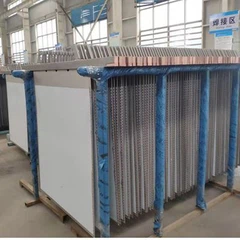
In the copper electrolytic (and electrolytic) refining process, stainless steel cathode plates are used as reusable cathodes for metal deposition. Stainless steel cathode plates consist of conductive rods, stainless steel plates, and insulating clamping strips.
Hanger bar: A bar that fixes the stainless steel cathode plate and can be hung on the conductive device to play a conductive and supporting role.
Stainless Steel Plate: A plate immersed in electrolyte as a cathode deposition area to precipitate high-purity non-ferrous metals after electrolytic deposition.
Edge strip: An insulating edge strip used to isolate the two sides of the stainless steel cathode plate from contact with the electrolyte to prevent the electrolytic deposits from precipitating on both sides of the edge. The insulating edge strip consists of a clamp and a tensioning round bar.


3 Stainless steel cathode plate process equipment and process control
3.1 The conductive rod forming process adopts a one-time forming process, and the stainless steel and copper rods should form an interference fit.
3.2 The lifting port processing in the stainless steel plate should adopt a laser cutting system.
3.3 The stainless steel plate should be leveled with a multi-roller plate leveling machine.
3.4 V-groove milling should be processed by CNC machine tools using forming tools.
3.5 The welding of the stainless steel cathode plate adopts a fully automatic laser welding production line, which includes self-melting welding technology, low-temperature welding technology and double-sided full welding technology.
3.6 Each stainless steel cathode plate shall have a unique traceable code, which shall be marked on the stainless steel cathode plate in the form of a QR code through laser engraving.
3.7 The insulating edge strip extrusion production line shall have automatic temperature control, water cooling, traction and cutting functions.
4. Inspection requirements for stainless steel cathode plates
4.1 Appearance requirements: There shall be no obvious scratches, nicks, breakages, burrs or debris on the surface of the cathode plate.
The edges shall be free of burrs and sharp edges; the insulating edge strip shall be fixed in place, reliably fastened and not loose;
The conductive rod shall have no obvious scratches, nicks, breakages or burrs.
4.2 Welding requirements: There shall be no defects such as cracks, incomplete penetration or incomplete fusion on the surface of the weld and heat-affected zone. The tensile strength of the welded joint shall not be less than 485MPa.
4.3 Conductivity requirements: The resistance from the contact point at one end of the conductive rod to the middle of the bottom of the stainless steel plate shall not be greater than 0.85mΩ, and the numerical deviation of the detection at both ends shall not be greater than 0.081mΩ. The average resistance deviation of the same batch of stainless steel cathode plates should not be greater than 0.08mΩ.
Send Inquiry