

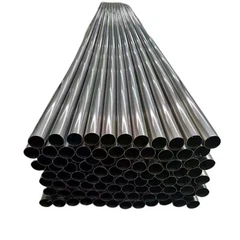


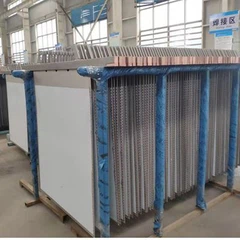


Titanium Heat Exchanger
High temperature resistance: (400 ℃),
High pressure resistance: (2.5Mpa)
Heat exchange rate Qh (KW): 140~1350
Heat storage (KW): ≥ 30min Qh
Applicable steam pressure Mpa: 0.2~0.6
Heating water inlet and outlet temperature ℃: 10/60
Heating water cation force MPa: ≤ 0.003
Products Description
A Titanium Heat Exchanger is an energy-saving device that facilitates heat transfer between two or more fluids at different temperatures. It transfers heat from a fluid with a higher temperature to a fluid with a lower temperature, ensuring that the fluid temperature meets the specified process requirements. It is also one of the key pieces of equipment for improving energy utilization efficiency.
- Heat transfer coefficient: 6000–8000 W/m²·°C
- High-temperature resistance: 400°C
- High-pressure resistance: 2.5 MPa
- Heat exchange rate (Qh): 140–1350 kW
- Heat storage capacity: ≥ 30 min Qh
- Applicable steam pressure: 0.2–0.6 MPa
- Heating water inlet/outlet temperature: 10°C / 60°C
- Heating water cation concentration: ≤ 0.003 MPa
This version corrects inconsistencies in unit formatting, punctuation, and terminology while keeping the technical details accurate.
Shell and tube heat exchangers:
Diagram of Shell and Tube Heat Exchanger
A shell and tube heat exchanger (also known as a tube and tube heat exchanger) is a type of heat exchanger mainly composed of a shell, tube bundle, tube plate, and head. The shell is typically cylindrical and contains either parallel tube bundles or spiral tubes inside. The two ends of the tube bundle are fixed onto the tube plate.
A shell and tube heat exchanger utilizes two types of fluids for heat exchange. One fluid flows inside the tubes, which is referred to as the tube side, while the other flows outside the tubes, known as the shell side. The heat transfer occurs through the wall surface of the tube bundle.
The tube diameters typically range from 16 mm, 20 mm, to 25 mm, with wall thicknesses of 1 mm, 1.5 mm, 2 mm, and 2.5 mm. Some imported heat exchangers feature smaller tube diameters, with a minimum of 8 mm and a wall thickness as thin as 0.6 mm, significantly improving heat exchange efficiency. Since 2012, these high-efficiency designs have been increasingly adopted in the domestic market.
Shell and tube heat exchangers with spiral tube bundle designs can maximize turbulence effects, thereby enhancing heat transfer efficiency. The asymmetric design of the internal shell and tube layers can achieve up to 4.6 times the standard efficiency, making it widely used in steam-water heat exchange applications. The maximum heat exchange efficiency can reach 14,000 W/m²·K, significantly improving production efficiency and reducing costs.
Additionally, since shell and tube heat exchangers are primarily made of metal, the introduction of China's new GMP (Good Manufacturing Practice) regulations has led to stainless steel 316L heat exchangers becoming a required standard in the beverage, food, and pharmaceutical industries.
Products Picture show


Hot Tags: titanium heat exchanger, China titanium heat exchanger manufacturers, suppliers, factory, gr5 titanium rod, titanium rod, titanium forged ring, , titanium equipment, molybdenum target
You Might Also Like


Send Inquiry